Quick Answer
As businesses grow, so do their operational challenges. Managing customers, handling finances, streamlining workflows, tracking inventory, improving employee productivity, and delivering exceptiona...
As businesses grow, so do their operational challenges. Managing customers, handling finances, streamlining workflows, tracking inventory, improving employee productivity, and delivering exceptional customer experiences all require the right technology.
At some point, every growing business faces a critical question:
Should we build custom software or buy an existing solution?
The answer is not always straightforward.
While purchasing ready-made software can provide immediate functionality and faster deployment, custom software offers flexibility, scalability, and a solution tailored to your unique business needs.
Making the wrong decision can lead to wasted investments, operational inefficiencies, and long-term limitations. On the other hand, choosing the right approach can improve productivity, reduce costs, and create a competitive advantage.
In this guide, we'll explore the advantages and disadvantages of both options and provide a practical decision-making framework that helps growing businesses determine whether they should build or buy software.
Key Takeaways
- Buying software offers faster implementation and lower upfront costs.
- Building software provides greater flexibility, customization, and scalability.
- The best choice depends on your business goals, processes, budget, and long-term growth plans.
- Off-the-shelf software works well for common business functions.
- Custom software is often ideal for businesses with unique workflows or specialized requirements.
- A structured evaluation process helps businesses make smarter technology investments.
Why This Decision Matters
Technology has become the backbone of modern business operations.
Whether you're managing sales, marketing, customer support, inventory, logistics, finance, or human resources, software plays a vital role in daily operations.
Choosing the wrong software strategy can result in:
- Reduced productivity
- Higher operational costs
- Poor user adoption
- Limited scalability
- Security concerns
- Missed growth opportunities
That's why businesses should carefully evaluate both options before making a significant investment.
Understanding the "Buy" Approach
Buying software means purchasing or subscribing to an existing software solution developed by a third-party provider.
Examples include:
- CRM systems
- Accounting software
- Project management tools
- HR platforms
- Marketing automation software
- Inventory management systems
These solutions are designed to serve a broad audience and are typically available through subscription-based pricing models.
Advantages of Buying Software
Faster Deployment
One of the biggest benefits of buying software is speed.
Most platforms can be implemented within days or weeks rather than months.
This allows businesses to solve immediate operational challenges quickly.
Lower Initial Investment
Buying software usually requires less upfront capital than developing a custom solution.
Businesses can often start with monthly or annual subscription plans.
Proven Functionality
Established software products have already been tested by thousands of users.
This reduces technical risks and provides confidence in system stability.
Ongoing Updates and Support
Software vendors typically handle:
- Updates
- Security patches
- Maintenance
- Technical support
This reduces the burden on internal teams.
Predictable Costs
Subscription pricing makes budgeting easier because costs are generally fixed and transparent.
Challenges of Buying Software
While buying software offers convenience, it also comes with limitations.
Limited Customization
Off-the-shelf software is designed for general use.
Your business may need to adjust its processes to fit the software rather than the other way around.
Feature Overload
Many platforms include features you may never use.
Businesses often pay for functionality that provides little value.
Integration Challenges
Existing software may not integrate seamlessly with your current systems.
This can create inefficiencies and data silos.
Vendor Dependency
Your business becomes dependent on the vendor's:
- Pricing structure
- Product roadmap
- Support quality
- Feature availability
Changes beyond your control can impact operations.
Scaling Limitations
As your business grows, software limitations may become more noticeable.
You may eventually outgrow the platform entirely.
Understanding the "Build" Approach
Building software involves creating a custom solution designed specifically for your business.
The software is developed based on your workflows, goals, and operational requirements.
Examples include:
- Custom ERP systems
- Industry-specific applications
- Customer portals
- Internal workflow platforms
- SaaS products
- AI-powered business tools
Custom software is built to solve unique business challenges that standard software cannot address effectively.
Advantages of Building Software
Tailored to Your Business
Custom software is designed around your exact requirements.
Instead of adapting your business to software limitations, the software adapts to your business.
This often leads to greater efficiency and user adoption.
Competitive Advantage
Custom software can provide capabilities that competitors cannot easily replicate.
This creates differentiation and supports long-term growth.
Greater Scalability
As your business grows, custom software can evolve alongside your needs.
New features, integrations, and capabilities can be added without relying on third-party vendors.
Better Integration
Custom solutions can connect seamlessly with existing systems and workflows.
This improves data consistency and operational efficiency.
Full Ownership and Control
Businesses maintain control over:
- Features
- Development priorities
- Security
- Infrastructure
- User experience
This level of control is not possible with most commercial software products.
Challenges of Building Software
Custom development also comes with important considerations.
Higher Initial Investment
Building software typically requires a larger upfront investment.
Development costs depend on complexity, features, and project scope.
Longer Development Timeline
Custom solutions take time to design, develop, test, and deploy.
Businesses must plan accordingly.
Ongoing Maintenance
Unlike purchased software, custom applications require ongoing:
- Updates
- Security management
- Bug fixes
- Feature enhancements
This requires a long-term commitment.
Project Risk
Software projects can face challenges such as:
- Scope changes
- Budget overruns
- Delays
Working with experienced development partners helps reduce these risks.
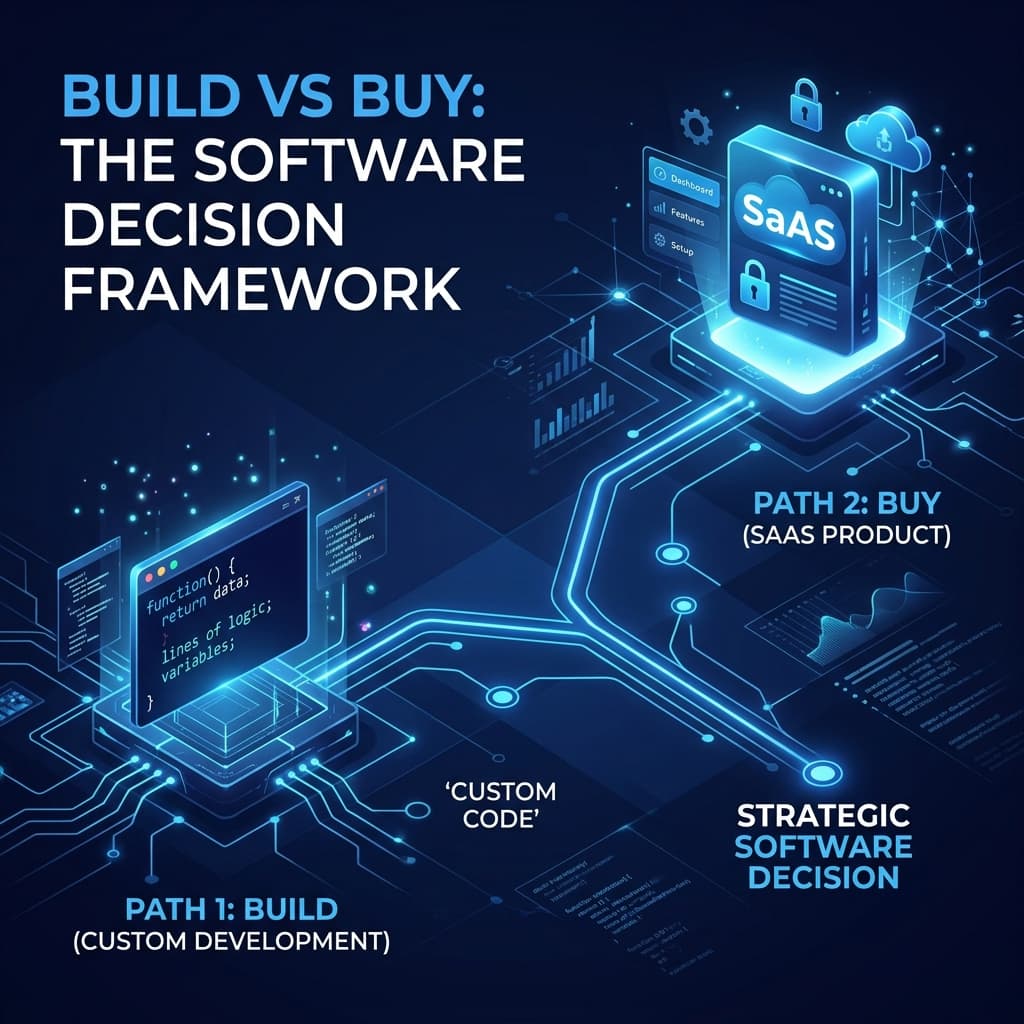
A Practical Build vs Buy Decision Framework
To determine the right approach, businesses should evaluate several key factors.
1. How Unique Are Your Processes?
Ask yourself:
Do your workflows differ significantly from industry standards?
If your business follows common processes, purchased software may be sufficient.
If your operations are highly specialized, custom software may offer greater value.
2. What Is the Strategic Importance?
Not all software has the same impact on business success.
For example:
- Email systems are generally not a competitive advantage.
- Proprietary customer experiences may be a major differentiator.
If software directly impacts competitive positioning, building may be the better option.
3. What Are Your Growth Plans?
Businesses expecting rapid growth should consider future scalability.
Will the software support your organization three to five years from now?
If not, custom development may be a smarter long-term investment.
4. What Is Your Budget?
Budget considerations are important.
Buying software typically requires lower upfront costs.
Building software often delivers greater long-term value but requires a larger initial investment.
Decision-makers should evaluate total cost of ownership rather than only initial expenses.
5. How Quickly Do You Need a Solution?
Urgent business needs often favor purchased software.
If speed is critical, buying may be the practical choice.
If long-term optimization is the priority, custom development may justify the additional time investment.
6. What Are Your Security and Compliance Requirements?
Industries such as healthcare, finance, and insurance often have strict compliance requirements.
Custom software can provide greater control over security and regulatory standards.
When Buying Software Makes the Most Sense
Buying software is often the right choice when:
- Requirements are standard.
- Speed is important.
- Budget is limited.
- Internal technical resources are unavailable.
- Long-term customization is not a priority.
Examples include:
- Accounting software
- Payroll systems
- Team collaboration tools
- Email marketing platforms
These functions are generally well-served by mature software products.
When Building Software Makes the Most Sense
Custom software becomes valuable when:
- Processes are highly unique.
- Competitive advantage is important.
- Scalability is a major concern.
- Existing software fails to meet requirements.
- Integration needs are complex.
Examples include:
- Industry-specific platforms
- Customer-facing applications
- Internal operational systems
- AI-powered automation solutions
- SaaS products
In these scenarios, custom development often delivers superior long-term value.
The Hidden Cost of Choosing the Wrong Option
Many businesses focus solely on upfront costs.
However, hidden costs often emerge later.
For purchased software:
- Licensing fees increase.
- Customization becomes difficult.
- Integrations require additional tools.
- Vendor limitations create inefficiencies.
For poorly planned custom software:
- Development costs increase.
- Technical debt accumulates.
- Maintenance becomes challenging.
The goal should be selecting the option that delivers the highest long-term business value.
Hybrid Approaches: The Best of Both Worlds
Many successful organizations adopt a hybrid strategy.
They purchase software for standard business functions while building custom solutions for strategic operations.
For example:
- Buy accounting software.
- Buy email marketing tools.
- Build a custom customer portal.
- Build an AI-powered workflow platform.
This approach balances speed, cost, flexibility, and innovation.
Why More Growing Businesses Are Investing in Custom Software
As markets become increasingly competitive, businesses are seeking technology solutions that support differentiation and growth.
Custom software allows organizations to:
- Improve efficiency
- Enhance customer experiences
- Automate unique workflows
- Gain better business insights
- Build scalable digital assets
Rather than being limited by generic solutions, businesses can create systems designed specifically for their success.
Conclusion
The decision to build or buy software is one of the most important technology choices a growing business can make. There is no universal answer because every organization has unique goals, workflows, budgets, and growth plans.
Buying software provides speed, affordability, and convenience, making it an excellent choice for common business functions. Building software offers flexibility, control, scalability, and competitive advantages that off-the-shelf solutions often cannot provide.
The key is evaluating your business needs strategically rather than focusing solely on short-term costs. By considering factors such as process complexity, scalability, integration requirements, security needs, and long-term objectives, businesses can make smarter technology investments that support sustainable growth.
Ultimately, the best software decision is the one that enables your business to operate more efficiently, serve customers better, and achieve its long-term vision.
Ready to Build Software That Fits Your Business?
Every business is unique, and your software should be too. Whether you're evaluating existing platforms, planning a custom solution, or exploring a hybrid approach, making the right technology decision can have a lasting impact on your growth.
At SlingVerse, we help businesses assess their requirements, design scalable solutions, and develop custom software that aligns with their goals. From internal business applications and customer portals to enterprise systems and AI-powered platforms, our team delivers technology built for long-term success.
Book a free consultation today and discover whether custom software is the right investment for your business growth journey.