Quick Answer
Compare AI automation and robotic process automation across capabilities, use cases, cost, governance, and implementation strategy.
AI Automation vs RPA at a Glance
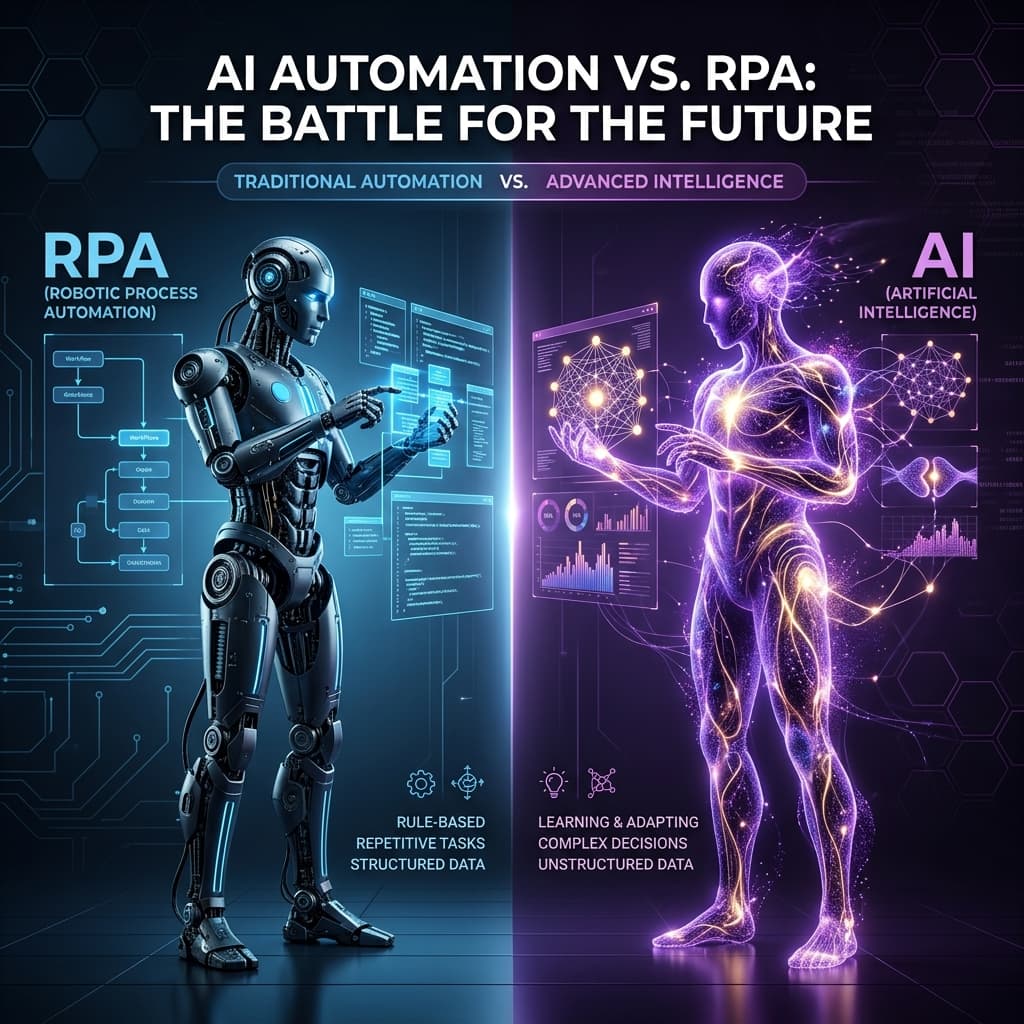
Robotic process automation, or RPA, reproduces defined user actions across software interfaces. AI automation interprets information, identifies patterns, generates outputs, or recommends decisions. RPA is strongest when rules and screens are stable; AI is useful when inputs are unstructured or judgment is required.
| Factor | RPA | AI automation |
|---|---|---|
| Primary strength | Repeating deterministic tasks | Interpreting and deciding from complex inputs |
| Typical inputs | Structured fields and stable screens | Documents, messages, images, speech, and mixed data |
| Behavior | Rule-based | Probabilistic with rules and guardrails |
| Exception handling | Predefined branches | Classification, confidence scoring, and human review |
| Governance focus | Bot access and process stability | Data quality, model behavior, privacy, and evaluation |
What RPA Does Best
RPA works well for copying data between stable systems, downloading reports, reconciling known fields, creating records, and triggering routine actions. It is predictable and auditable when the workflow has explicit rules, but interface changes can break screen-based bots.
What AI Automation Does Best
AI automation can classify support requests, extract meaning from contracts, summarize case histories, identify anomalies, draft responses, and route work based on context. Because model outputs are probabilistic, production systems need evaluations, confidence thresholds, monitoring, and human escalation.
When to Use RPA
- The process is stable, repetitive, and rules-based.
- Inputs are structured and exceptions are limited.
- No reliable API exists and interface automation is acceptable.
- Exact repetition matters more than interpretation.
When to Use AI Automation
- The workflow contains documents, email, chat, images, or speech.
- Teams must classify, summarize, extract, predict, or generate.
- Rules alone cannot cover the volume of real-world variations.
- Human reviewers need faster analysis and better context.
Why Hybrid Automation Is Often the Best Choice
AI and RPA are complementary. An AI service might read an invoice and return validated fields, while an RPA bot enters those fields into a legacy desktop application. APIs and workflow orchestration should be preferred when available, with RPA used at interface boundaries that cannot be integrated directly.
Cost, Risk, and Governance Differences
RPA costs tend to center on bot licenses, development, infrastructure, and maintenance when interfaces change. AI automation adds model usage, evaluation, data preparation, privacy controls, and ongoing quality monitoring. Both require least-privilege access, audit trails, exception handling, and operational ownership.
How to Choose the Right Approach
Map the task, input type, decision complexity, system interfaces, error cost, and required auditability. Choose the simplest reliable approach: deterministic workflow logic first, APIs where possible, RPA for stable interface repetition, and AI where interpretation creates measurable value. SlingVerse can help assess the workflow through an AI automation discovery engagement.