Quick Answer
Artificial Intelligence (AI) has quickly moved from being a futuristic concept to a critical business tool. Today, organizations across industries are using AI to automate processes, improve custom...
Artificial Intelligence (AI) has quickly moved from being a futuristic concept to a critical business tool. Today, organizations across industries are using AI to automate processes, improve customer experiences, analyze data, and increase operational efficiency. As AI adoption grows, many businesses initially turn to popular AI tools available in the market. These solutions are easy to access, affordable, and can provide immediate value.
However, as businesses grow and their requirements become more complex, many organizations discover that generic AI tools have limitations. They often fail to address specific business challenges, integrate seamlessly with existing systems, or provide the level of customization required for long-term success.
This is why modern enterprises are increasingly investing in custom AI solutions. Instead of adapting their processes to fit a generic tool, they are building AI systems tailored to their unique goals, workflows, and data.
In this article, we will explore why custom AI solutions are replacing generic AI tools, the advantages they offer, and how businesses can leverage them to gain a competitive advantage.
Key Takeaways
- Generic AI tools are useful for basic tasks but often lack flexibility for complex business requirements.
- Custom AI solutions are designed around a company's unique processes, data, and objectives.
- Businesses can achieve better efficiency, accuracy, and scalability with tailored AI systems.
- Custom AI improves data security and compliance by giving organizations greater control.
- AI solutions integrated with existing software and workflows deliver stronger business outcomes.
- Enterprises that invest in custom AI gain a sustainable competitive advantage in their industry.
Understanding Generic AI Tools
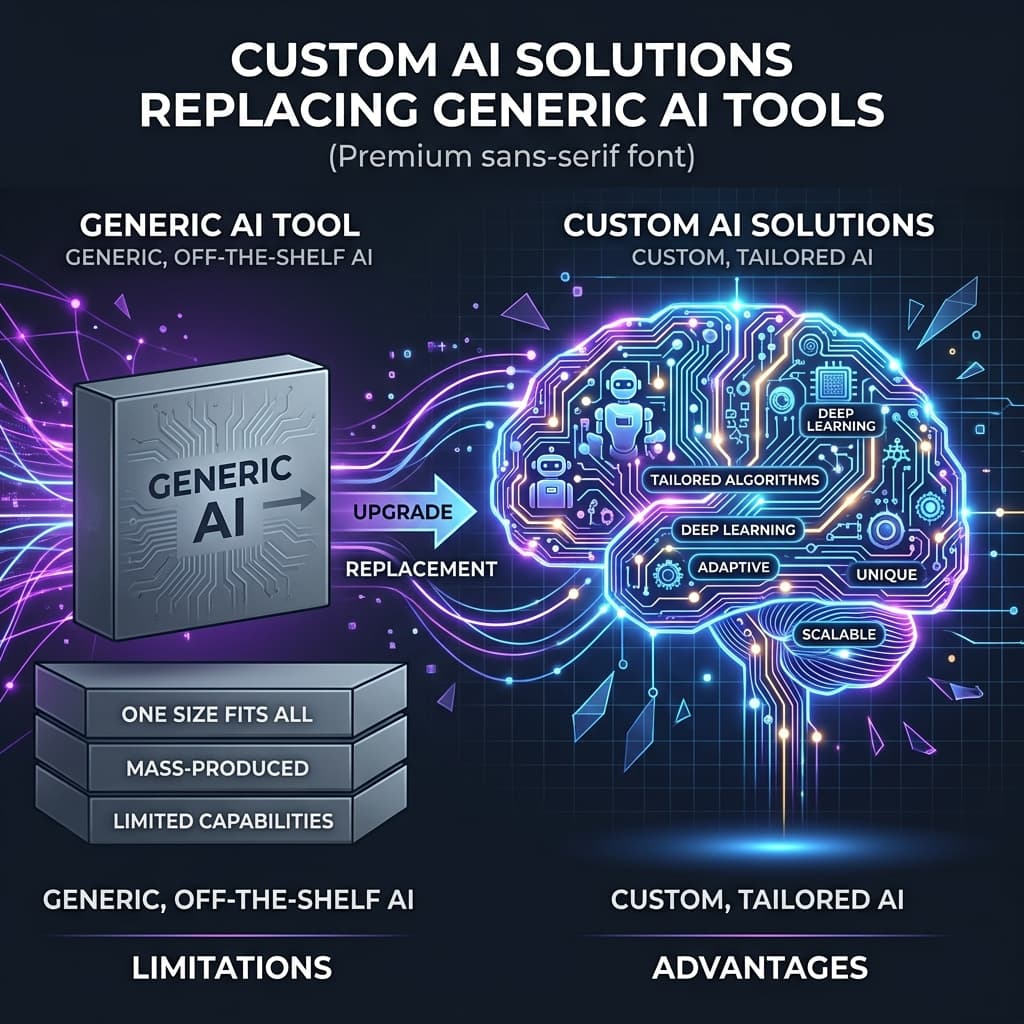
Generic AI tools are pre-built software platforms designed to serve a wide range of users. Examples include AI chatbots, content generation tools, workflow automation platforms, and predictive analytics solutions.
These tools are often designed with a one-size-fits-all approach. Their goal is to provide functionality that works reasonably well across different industries and use cases.
Some common benefits of generic AI tools include:
- Quick implementation
- Lower upfront investment
- Easy accessibility
- Minimal technical expertise required
- Ready-to-use features
For startups and small businesses, these tools can provide immediate value. They help organizations experiment with AI without significant investment.
However, as organizations grow, the limitations become more noticeable.
The Limitations of Generic AI Tools
While generic AI solutions are useful, they often struggle to meet enterprise-level requirements.
Limited Customization
Every business operates differently. Generic AI tools are designed for the masses, making it difficult to customize them according to specific business processes.
For example, a healthcare provider, logistics company, and financial institution all have unique workflows. A standard AI solution may not fully address their industry-specific needs.
Data Restrictions
Most generic AI platforms rely on predefined datasets or external models. They may not be trained on your organization's proprietary data, reducing accuracy and relevance.
Without access to company-specific information, AI outputs may fail to reflect actual business requirements.
Integration Challenges
Modern enterprises use multiple systems, including CRM platforms, ERP software, accounting tools, customer support systems, and internal databases.
Generic AI tools often require additional work to integrate with these systems, creating inefficiencies and data silos.
Scalability Concerns
What works for a small team may not work for an enterprise handling millions of transactions or customer interactions.
Generic tools can become costly or inefficient as usage increases.
Security and Compliance Risks
Many industries operate under strict compliance regulations. Generic AI platforms may not provide the level of data control required to meet industry standards.
For organizations handling sensitive information, this can become a major concern.
What Are Custom AI Solutions?
Custom AI solutions are AI systems designed specifically for a business's unique requirements.
Instead of relying on pre-built functionality, custom AI applications are developed using the organization's data, workflows, objectives, and industry requirements.
Examples include:
- AI-powered customer support systems
- Intelligent document processing
- Predictive maintenance platforms
- Personalized recommendation engines
- Fraud detection systems
- AI-driven supply chain optimization
- Custom virtual assistants
- Industry-specific machine learning models
These solutions are built to solve specific problems rather than provide general-purpose functionality.
Why Enterprises Are Moving Toward Custom AI Solutions
1. Better Alignment with Business Goals
One of the biggest advantages of custom AI is alignment.
Generic tools force businesses to adapt their processes around software limitations. Custom AI does the opposite.
The AI system is designed around existing workflows and business objectives, making it more effective and easier to adopt.
This results in higher productivity and stronger business outcomes.
2. Improved Accuracy Through Proprietary Data
Data is the foundation of AI.
Custom AI models can be trained using an organization's historical data, customer information, operational records, and industry-specific datasets.
Because the system learns from business-specific information, it often delivers significantly higher accuracy than generic alternatives.
For example:
- Retail companies can predict customer behavior more accurately.
- Manufacturers can identify equipment failures earlier.
- Financial institutions can improve fraud detection capabilities.
The more relevant the data, the better the results.
3. Seamless Integration with Existing Systems
Modern businesses rely on multiple software applications.
Custom AI solutions can integrate directly with:
- CRM platforms
- ERP systems
- Marketing automation tools
- Customer service platforms
- Inventory management systems
- Internal databases
This creates a connected ecosystem where data flows smoothly across departments.
As a result, teams can make faster decisions and eliminate manual processes.
4. Greater Automation Capabilities
Many enterprises invest in AI to automate repetitive tasks.
Generic tools typically automate common workflows, but custom AI can automate highly specialized processes.
Examples include:
- Automated invoice processing
- Intelligent lead qualification
- Predictive inventory management
- Contract analysis
- Customer sentiment analysis
These advanced automation capabilities can save thousands of work hours annually.
5. Enhanced Security and Compliance
Data privacy is becoming increasingly important.
Organizations in healthcare, finance, insurance, and government sectors must comply with strict regulations.
Custom AI solutions provide greater control over:
- Data storage
- Access permissions
- Security protocols
- Compliance requirements
Businesses can ensure their AI systems align with industry regulations while protecting sensitive information.
6. Scalability for Future Growth
As organizations grow, their technology must grow with them.
Custom AI solutions are designed with scalability in mind.
Businesses can continuously expand capabilities, add new features, and improve performance without being restricted by vendor limitations.
This flexibility helps future-proof technology investments.
Real-World Applications of Custom AI
Customer Service
Many enterprises are replacing traditional support systems with AI-powered customer assistants trained on their internal knowledge base.
These systems provide:
- Faster responses
- Improved customer satisfaction
- Reduced support costs
- 24/7 assistance
Supply Chain Optimization
Custom AI helps businesses forecast demand, optimize inventory levels, and improve logistics planning.
This reduces waste and improves operational efficiency.
Human Resources
AI-powered recruitment systems can analyze resumes, identify top candidates, and automate interview scheduling.
This accelerates hiring while improving candidate quality.
Financial Services
Banks and financial institutions use custom AI to detect fraud, assess risks, and improve compliance monitoring.
These systems continuously learn from transaction patterns and evolving threats.
Manufacturing
Manufacturers use AI for predictive maintenance and quality control.
By identifying issues before equipment failures occur, companies reduce downtime and maintenance costs.
The Competitive Advantage of Custom AI
Technology alone is not a competitive advantage anymore.
The real advantage comes from how businesses use technology.
When multiple competitors use the same generic AI tools, they often gain similar benefits.
Custom AI creates differentiation.
Organizations can build capabilities that competitors cannot easily replicate because the system is based on proprietary data, internal processes, and unique business knowledge.
This creates long-term value and sustainable market advantages.
Common Misconceptions About Custom AI
"Custom AI Is Only for Large Enterprises"
This is no longer true.
Advancements in cloud computing and AI frameworks have made custom development more accessible than ever.
Many startups and mid-sized businesses now invest in custom AI solutions.
"Custom AI Takes Years to Build"
Modern development approaches allow businesses to launch AI-powered solutions much faster.
Many organizations begin with a pilot project and scale gradually.
"Generic AI Is Always Cheaper"
While generic tools may have lower upfront costs, ongoing subscription fees, inefficiencies, and limitations can become expensive over time.
Custom AI often delivers greater long-term ROI.
How to Get Started with Custom AI Development
Businesses considering custom AI should begin with a clear strategy.
Identify Business Challenges
Focus on specific problems that AI can solve.
Examples include:
- Manual workflows
- Customer service bottlenecks
- Data analysis challenges
- Operational inefficiencies
Evaluate Existing Data
High-quality data is essential for successful AI implementation.
Organizations should assess the availability, quality, and accessibility of their data.
Start Small
Rather than transforming everything at once, start with a focused project that delivers measurable results.
Partner with Experienced AI Developers
Working with an experienced AI development team helps ensure the solution is aligned with business goals and delivers maximum value.
Conclusion
Generic AI tools have played an important role in helping businesses adopt artificial intelligence. They offer convenience, accessibility, and quick implementation.
However, as organizations mature and their needs become more sophisticated, generic solutions often fall short. Businesses require systems that understand their unique operations, leverage proprietary data, integrate with existing infrastructure, and scale alongside growth.
This is why custom AI solutions are becoming the preferred choice for modern enterprises.
By investing in AI tailored to their specific objectives, organizations can improve efficiency, enhance customer experiences, strengthen security, and build a sustainable competitive advantage. In an increasingly digital world, custom AI is no longer just an option—it is becoming a strategic necessity for businesses that want to lead their industries.
Ready to Build a Custom AI Solution for Your Business?
Every business has unique challenges, and generic AI tools can only take you so far. At SlingVerse, we design and develop custom AI solutions tailored to your workflows, goals, and industry requirements.
Whether you're looking to automate operations, build intelligent applications, improve customer experiences, or unlock insights from your data, our AI experts can help you create a scalable solution that delivers measurable results.
Book a free consultation today and discover how custom AI can transform your business.