Quick Answer
Optimize speed, security, and search indexing. Read why Next.js, React, Tailwind CSS, and cloud caching form the best stack for 2026.
The Evolution of Web Architecture
In 2026, the standard for a "good" website has never been higher. Search engines demand instant load times, perfect Core Web Vitals, and seamless mobile responsiveness. Users expect dynamic, app-like experiences without sacrificing speed. To meet these demands, ambitious businesses must abandon legacy architectures (like monolithic WordPress or standard PHP) and embrace the modern engineering stack.
The Ultimate Modern Tech Stack
At SlingVerse, we architect enterprise-grade web applications designed for maximum performance, security, and scalability. Here is the definitive tech stack for modern business websites.
Frontend: Next.js and React
React remains the industry standard for building interactive user interfaces, but Next.js has revolutionized how React apps are delivered. Next.js is a meta-framework that provides Server-Side Rendering (SSR) and Static Site Generation (SSG) out of the box.
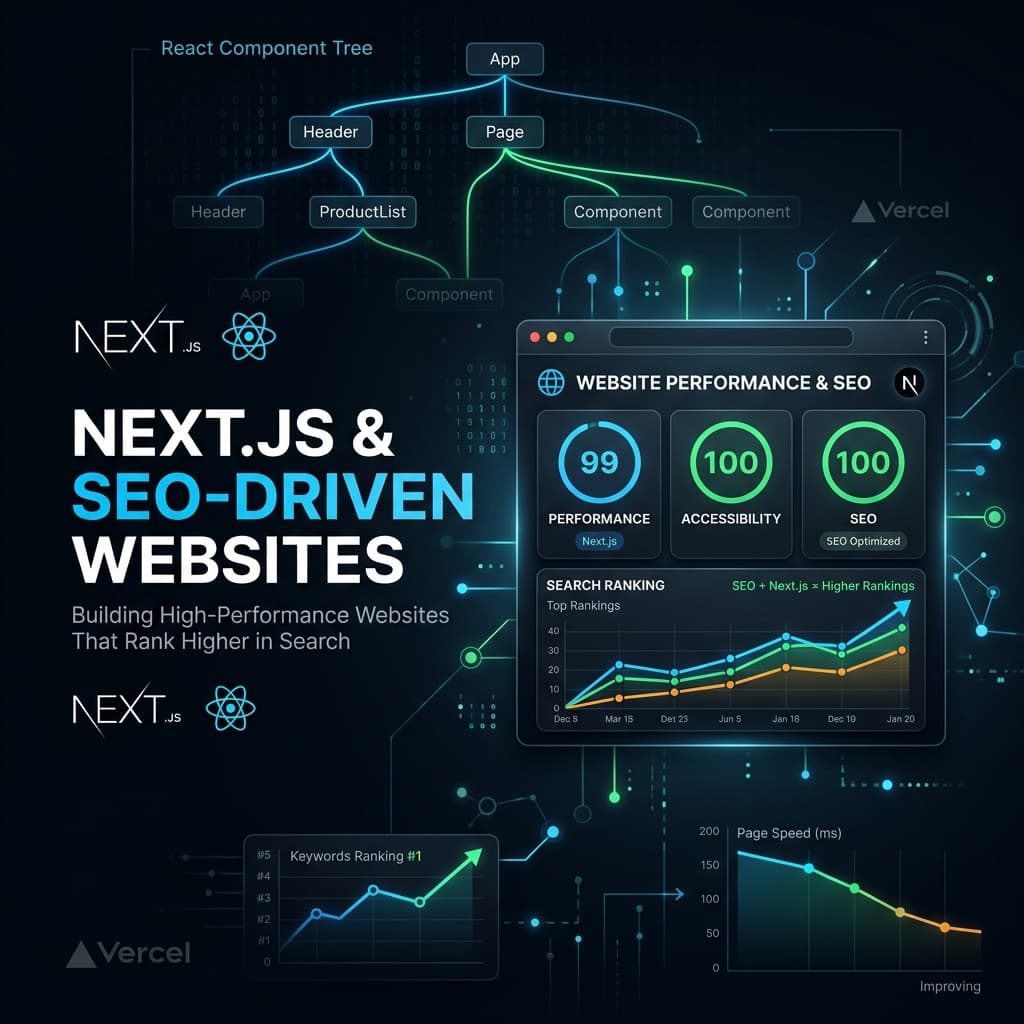
- SEO Dominance: Because Next.js renders HTML on the server, search engine crawlers can instantly read your content, resulting in massive SEO advantages over traditional Single Page Applications (SPAs).
- Lightning Speed: Next.js optimizes images, fonts, and scripts automatically, ensuring perfect Core Web Vitals and near-instant page loads.
- Edge Computing: With Next.js deployed on Edge networks, your website is served from the server closest to your user globally, eliminating latency.
Styling: Tailwind CSS
Tailwind CSS is a utility-first CSS framework that has completely replaced traditional stylesheets and heavy UI libraries like Bootstrap.
- Zero Bloat: Tailwind automatically purges unused CSS in production, resulting in tiny stylesheet payloads.
- Design System Consistency: By configuring a strict `tailwind.config.js`, engineering teams can ensure perfectly consistent typography, spacing, and brand colors across massive applications.
- Rapid Prototyping: Developers can build highly complex, responsive layouts directly within the React components, radically speeding up development time.
Backend & API: Node.js / tRPC / GraphQL
While Next.js provides excellent API routes for monolithic full-stack applications, enterprise systems often require dedicated backend services.
- Node.js & Express: The standard for highly concurrent, fast, and scalable microservices.
- tRPC: For full-stack TypeScript applications, tRPC allows for end-to-end typesafety without code generation, meaning frontend engineers immediately catch backend API changes at compile time.
Database & ORM: PostgreSQL & Prisma
Relational data is the backbone of business applications.
- PostgreSQL: The most robust, open-source relational database, perfectly suited for complex queries and massive datasets.
- Prisma ORM: The modern standard for interacting with databases in TypeScript. Prisma provides type-safe database access, auto-generated migrations, and an incredible developer experience that prevents runtime errors.
Headless CMS: Sanity or Strapi
Marketing teams need control over content without touching code. Headless Content Management Systems decouple the backend content repository from the frontend presentation layer.
- By integrating Strapi or Sanity with Next.js, content editors get a beautiful dashboard to manage blogs and landing pages, while developers retain complete control over the React codebase to ensure maximum performance.
Conclusion
Choosing the right tech stack is a multi-million dollar decision for growing enterprises. By adopting Next.js, Tailwind, TypeScript, and robust headless architectures, businesses future-proof their digital infrastructure, ensure maximum SEO visibility, and deliver world-class user experiences.